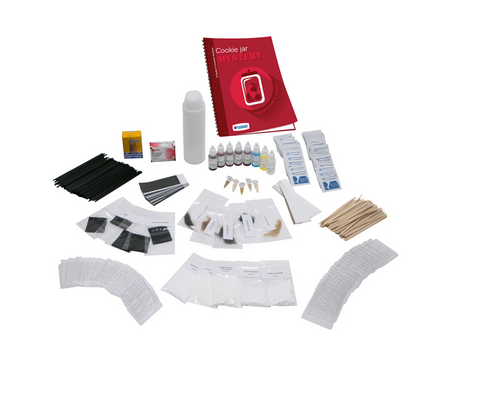
Cookie Jar Mystery: A Study in Forensic Science Summer Camp Kit
Community Learning
- SKU:
- CJM1100-SC
- Shipping:
- Calculated at Checkout
- Grades:
- 4-5
- Group Size:
- 2-4
Welcome!
This fun, interactive, project-oriented forensic science course is designed to engage students Grades 4-5 in this truly fascinating area of science! Your students will become immersed in roles as crime scene investigators as they work together examining and analyzing evidence needed to solve the mystery of the broken cookie jar!
Crime Scenario
A crime has occurred in Mrs. Randall’s classroom! Her favorite cookie jar was broken, and some of her homemade cookies were eaten. While breaking a cookie jar and snitching a few cookies are hardly serious crimes, they are nevertheless crimes that can be solved using a forensic science approach.
Mrs. Randall turns this misfortune into opportunity and calls in a “Chief Crime Scene Investigator” (your teacher) to lead her “forensics team” (your students) in how to use the tools of forensic science in analyzing clues left at the crime scene. Each student member of this investigative team is tasked with solving the mystery through scientific observation, sample examination, analysis, lab work, testing, interviews, and fieldwork.
Course Outline
The Cookie Jar Mystery is comprised of 12 lessons, designed each to take approximately 1-hour, for a class of 30 students. Your class size and ability level will determine the ultimate pace for the materials.
Lesson 1: Heads Up-Observation Skills: You can't believe your eyes, or can you? Budding CSI investigators love to explore the challenge of visual memory and eyewitness testimony in this activity of "Did You See That?"
Lesson 2: Think Ink-Ink Chromatography: The telltale composition of ink can help CSIs identify the perpetrator when students make their own ink chromatographs. Easy-to-follow instructions lead the way in your classroom's forensics laboratory.
Lesson 3: The White Stuff-White Substance and Toxicology: Take a powder, please! Students get a closer look at the differences in white substances, and at the world of poison science in this riveting research.
Lesson 4: Pull Some Strings-Fiber Analysis: Can scientific analysis of fibers help identify our thief? Students use pocket hand lenses to get up close and personal with fiber analysis, and learn to distinguish between class evidence and direct (conclusive) evidence.
Lesson 5: Hair We Go-Hair Sample:Who knew hair could be so complex? In this activity, can our junior gumshoes match a hair sample to the correct suspect? This absorbing inquiry will have students scratching their heads (and plucking their own hair!) as they delve deeper into the Cookie Jar Mystery.
Lesson 6: Follow the Grain-Pollen Analysis: Achoo! Pollen as evidence? Learners explore another form of trace evidence that often tells where something happened. Students do the legwork in the field as they practice with this essential tool.
Lesson 7: Make an Impression-Bite Marks: Surprisingly simple materials provide all you need for another great lesson in comparing and contrasting for students to "sink their teeth into."
Lesson 8: Bloody Brilliant-Blood Types: Of course, it's not real blood - but we do provide blood evidence substitute that encourages learners to handle evidence just like genuine CSI laboratory technicians. This lesson in blood typing provides a great jump start for future scientists, geneticists and crime scene detectives.
Lesson 9: One of a Kind-Fingerprint Evidence: Oh, the things we leave behind! Everything you always wanted to know about whorls and ridges, fingerprinting technique and more with authentic Ten Cards for each student to make a record of his/her prints.
Lesson 10: Crack the Code-DNA: Learning to unravel the mystery of our genetic code is revealed in this straightforward explanation, and the lesson helps learners narrow the field of suspects.
Lesson 11: Let's Talk-Questioning Our Suspects: A lie detector isn't the only way of getting at the truth! In this lesson, our junior CSI detectives learn the meaning of the "norm" and how knowing the norm helps distinguish truth tellers from liars. Students also return to the "scene of the crime" for another look.
Lesson 12: Who Dunnit?-Examining & Analyzing All the Evidence: Means, motive, and opportunity all come together in this culminating activity that encourages students to put all of the puzzle pieces together and finally solve the Cookie Jar Mystery!
What's Included?
The Summer Camp version of the Cookie Jar Mystery contains an Instructor's Guide and a Teacher Resource Thumb Drive. Printed packet of all student handouts and every supply item necessary to teach a class of up to 30 students.
Instructor’s Guide
Every step is taken to provide an easy-to-follow format and informative, fun-to-read instructions for each lesson. In addition to a brief listing of objectives, materials, and set-up procedures, useful icons point the instructor to several key elements:
Notes for the Instructor: Brief instructor notes introduce the subject matter and challenges presented in the particular lesson. They often contain real-life, age-appropriate examples from crime in history or popular culture.
Notes for the Students: These notes “set the stage” for each lesson by presenting brief material to read, listen to, and discuss.
Vocabulary: New and relevant terms are defined here. Note, too, the comprehensive “Glossary” at the end of the Instructor’s Guide and Student Books.
Activity Description: Here, step-by-step procedures are provided for both the instructor’s demonstration and the students’ immersion in the activity.
Wrap-up: Discussion-provoking questions and summary-type activities are designed to revisit the day’s learning and help students investigate further.
Clean-up: Clear instruction on preserving and storing materials is provided to ensure kit longevity and cost-effectiveness.
Other Destinations: To extend lessons and deepen understanding across disciplinary and cultural divides, relevant links to multimedia, web resources, and fun at-home or extension activities are provided here.
Online Resources
Our companion site for the Cookie Jar Mystery includes all the copy masters for student handouts, activities, lesson extensions like crossword puzzles to reinforce newly learned used vocabulary, and learning aides. Links to forensic videos and other multimedia resources provide authentic lesson extensions and teacher tutorials for each hands-on activity, found here.
Supplies
The Cookie Jar Mystery Summer Camp Kit Includes:
| 1 x Instructor’s Guide | Online Teacher Resources |
| 1 x Pre-Printed Handout Bundle | 1 x Simulated Blood Set |
| 100 x Chromatography Paper | 1 x White Powder Set |
| 20 x Paper Plates | 1 x Suspect Pen Set |
| 16 x 250 mL Beakers | 1 x Container of Salt |
| 1 x Hair Sample Set | 100 x Plastic Straws |
| 1 x Black Fiber Sample Set | 15 x Hand lenses |
| 1 x Isopropyl Alcohol | 1 x Paper Clip Box |
| 1 x Packing Tape | 100 x Wooden splints |
| 1 x Toothpick Box | 50 x Black Paper Squares |
| 36 x Pencils | 50 x Portion Cups |
| 2 x Liter Water Bottle | 20 x Dropper Bottles |
| 12 x Permanent Markers | 50 x Foam Plates |
| 16 x Rolls of Transparent Tape | 32 x Ink strips |
| 15 x Colorful Rulers | 50 x Disposable Gloves |
| 15 x Measuring Spoon Set | 1 x Dish Soap |
| 15 x Plastic Tweezers | 1 x Pollen Sample Set |
| 50 x Coffee Filters | 15 x Plastic Spoons |
| 15 x Plastic Bags | 130 x Plastic Cups |
| 1 x Vinegar | 32 x Ink Removal Towelettes |
| 1 x Iodine & Dropper Set | 50 x Blood Exam Trays |
| 12 x Colorful Scissors |